
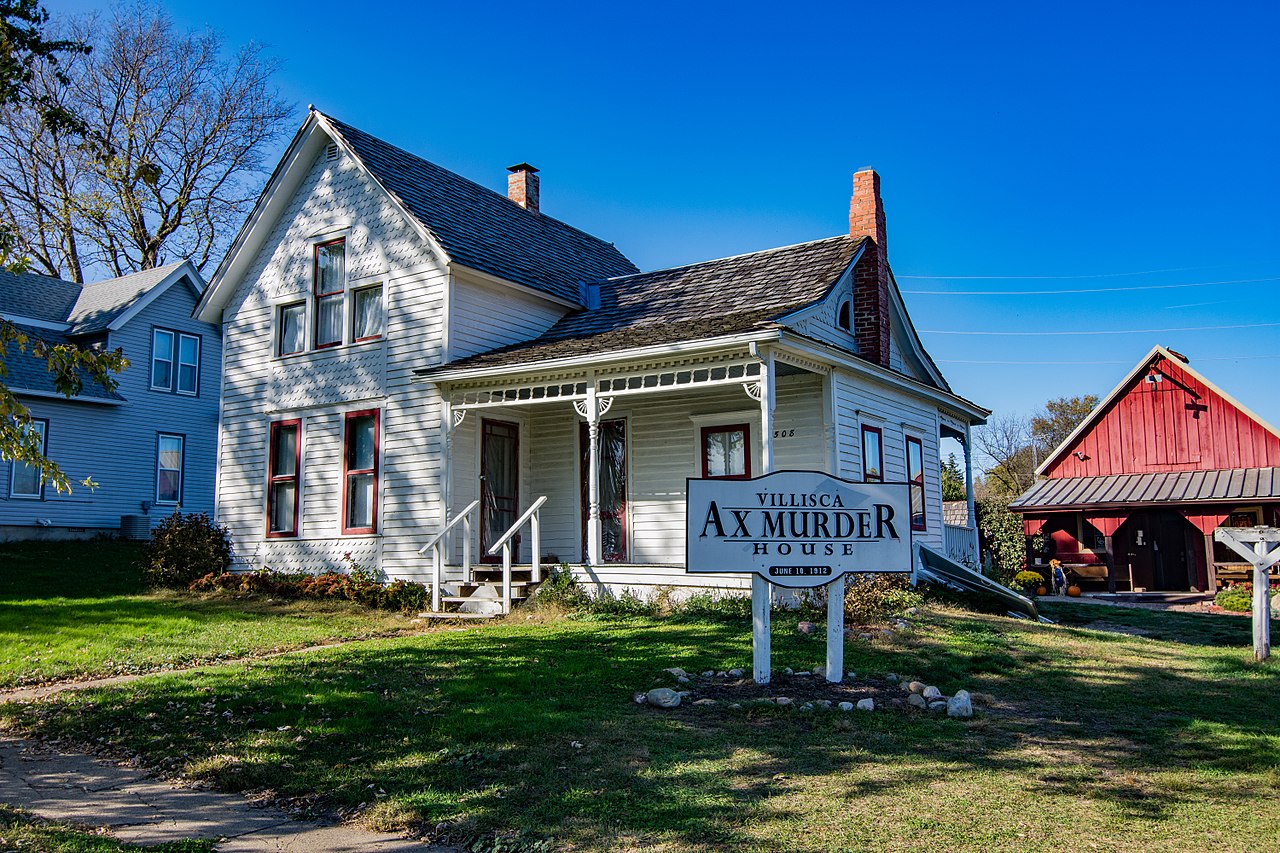
There are houses that hold their secrets close, and then there is 508 East 2nd Street in Villisca, Iowa — a white clapboard monument to unsolved horror that has drawn the curious and the morbid for over a century. In this modest farmhouse, on the suffocating night of June 9, 1912, eight people were butchered in their beds with an axe, and the killer simply vanished into the prairie darkness, leaving behind a puzzle that would consume a town and echo through generations.
The house still stands today, restored to its 1912 appearance, every detail preserved like a photograph of terror. Visitors can walk through rooms where blood once pooled on wooden floors, can climb the narrow stairs where a killer may have waited in the stifling attic, smoking cigarettes and listening to the family settle into their final sleep below. The building breathes with its own malevolent life, a shrine to violence that refuses to let the dead rest.
A Family Destroyed
Josiah Moore was a man of standing in Villisca — a successful businessman whose implement store competed fiercely with the established merchants of this small Iowa town. His wife Sarah was beloved in their Presbyterian church, a woman who coordinated children's programs and embodied the moral rectitude of rural America. Their four children — Herman, Mary Katherine, Arthur, and Paul — were the picture of wholesome midwestern youth.
On that fatal night, two additional children stayed as guests: sisters Ina May and Lena Gertrude Stillinger, aged 8 and 11. They had been invited by young Mary Katherine to spend the night after attending the Children's Day Program at the Presbyterian church. The eight of them returned home sometime between 9:45 and 10 p.m., walking through the warm June evening toward their waiting doom.
What happened next remains shrouded in the particular darkness that only comes with premeditated evil. Investigators believe the killer waited in the attic — two spent cigarettes found there suggest hours of patient observation. As the family slept, secure in their beds, the murderer crept downstairs with Josiah's own axe and began his methodical slaughter.
The Ritual of Murder
The killer began in the master bedroom where Josiah and Sarah lay sleeping. Josiah received the most savage treatment — blow after blow from the axe blade until his face was obliterated, his eyes completely destroyed. The ceiling above bore deep gouges where the murderer had lifted the weapon high before bringing it down again and again. Sarah received similar treatment, though investigators noted the killer used only the blunt end of the axe on the remaining victims.
Moving through the house like a methodical butcher, the killer next visited the children's rooms. Herman, Mary Katherine, Arthur, and Paul were each struck down in their beds, their young lives snuffed out before they could fully comprehend the nightmare that had entered their home. The murderer then returned to the master bedroom to inflict additional blows on the parents, knocking over a shoe that filled grotesquely with Josiah's blood.
Finally, the killer descended to the guest bedroom where the Stillinger sisters lay. Here, the violence took on a more disturbing character. While Ina May appeared to have died in her sleep, eleven-year-old Lena showed signs of having awakened and struggled. She was found lying crosswise on the bed with a defensive wound on her arm. Her body had been positioned to expose her genitalia, leading investigators to suspect sexual assault, though later examination found no evidence of this violation.
The Macabre Details
What investigators discovered in the house revealed a mind consumed by ritual and obsession. Every mirror in the house had been covered — with clothing pulled from dressers, with blankets, with anything the killer could find. Windows were draped with aprons and skirts to prevent anyone from peering inside. A four-pound slab of bacon had been taken from the icebox and placed beside the murder weapon, for reasons that remain incomprehensible.
A kerosene lamp was found upstairs, its glass chimney removed and wick turned down to provide only the faintest light — suggesting the killer had moved through the house by this dim illumination, perhaps to avoid detection or simply to create the proper atmosphere for his work. On the kitchen table sat untouched food and a bowl of bloodied water, mute witnesses to the killer's post-murder activities.
Outside in the barn, investigators found an impression in the hay near a knothole — evidence that someone had observed the family for some time before making their move. The killer had studied their habits, learned their routines, waited for the perfect moment to strike.
The Botched Investigation
By morning, neighbor Mary Peckham noticed the unusual quiet from the Moore house. When her knocks went unanswered and she found the doors locked, she summoned Ross Moore, Josiah's brother. Ross unlocked the front door and made the grisly discovery that would haunt Villisca forever.
What followed was a masterclass in how not to handle a crime scene. Within hours, the local telephone office had issued an "all call" alert, and the house was overrun with curiosity seekers. Townspeople trampled through the murder scene, handling evidence and even stealing pieces of Josiah's shattered skull as macabre souvenirs. The murder weapon was passed from hand to hand, contaminating any fingerprints or trace evidence it might have held.
It wasn't until nearly 24 hours after the murders that the National Guard finally secured the scene and the bodies were removed to a makeshift morgue in the fire station. By then, any hope of preserving crucial evidence had been destroyed by the morbid fascination of Villisca's residents.
Suspects in the Shadows
The investigation that followed was as byzantine as it was fruitless. Suspicion fell on a parade of characters, each more unlikely than the last. There was Reverend George Kelly, an English-born traveling minister with a history of mental illness who had been in town for the Children's Day services. Kelly would confess to the murders in court, then recant, displaying an obsessive fascination with the case that made him a prime suspect until two trials ended in acquittal.
Local businessman Frank F. Jones emerged as another suspect, driven by rumor and innuendo. Jones had formerly employed Josiah Moore, and their business relationship had soured when Moore opened his own store, taking customers and a lucrative John Deere dealership with him. Whispers suggested Moore had conducted an affair with Jones's daughter-in-law, though no evidence supported this salacious theory.
Perhaps most intriguing was William "Insane Blackie" Mansfield, an ex-convict and former soldier who may have been hired by Jones to eliminate his business rival. Mansfield was suspected in similar axe murders in Colorado Springs, Ellsworth, and Paola — part of a possible killing spree that stretched across the Midwest. The similarities were too striking to ignore: families slaughtered in their beds, windows covered to prevent discovery, the killer's methodical cleanup afterward.
The House That Horror Built
Today, the Villisca Axe Murder House stands as both monument and attraction, its white exterior concealing the darkness within. Restored to its 1912 appearance, it draws thousands of visitors each year — ghost hunters, true crime enthusiasts, and the merely curious who come to stand in rooms where unspeakable violence once unfolded.
The narrow staircase creaks under modern footsteps as it once did under the killer's boots. The small bedrooms feel claustrophobic, their low ceilings pressing down like the weight of unresolved murder. In the master bedroom, visitors can see the gouge marks in the ceiling, permanent scars from the night when evil walked these halls.
The kitchen maintains its period authenticity, down to the icebox where the bacon was stored and the table where the killer sat with his bloodied water. Every detail has been preserved, creating an experience that is part museum, part memorial, and part something altogether more unsettling.
The Lingering Darkness
More than a century has passed since that night of terror, yet the house seems to resist the passage of time. Visitors report unexplained phenomena — footsteps in empty rooms, doors that swing shut on their own, shadows that move without source. Whether these manifestations spring from genuine supernatural activity or the collective weight of expectation and horror, they serve to reinforce the building's reputation as one of America's most haunted locations.
The town of Villisca itself bears the permanent scar of the murders. What was once a thriving agricultural community of over 2,000 residents has shrunk to just over 1,100. The murders split the town along lines of suspicion and accusation that never fully healed. Families turned against each other, old friendships dissolved in pools of doubt and whispered theories.
The house at 508 East 2nd Street stands as a reminder that some mysteries resist solution, some wounds refuse to heal. It is a place where the past refuses to stay buried, where the echo of that terrible night continues to reverberate through the Iowa countryside. In its cramped rooms and darkened corners, eight souls met their end at the hands of a killer who walked away into history, leaving behind only questions that grow more compelling with each passing year.
The axe may have been set aside, the blood long since scrubbed from the floors, but the Villisca house remains what it became on that suffocating June night — a monument to the capacity for human evil and the enduring power of unsolved horror to capture our darkest fascinations.
Discussion (0)
Log in or register to join the discussion.
No comments yet. Be the first.