
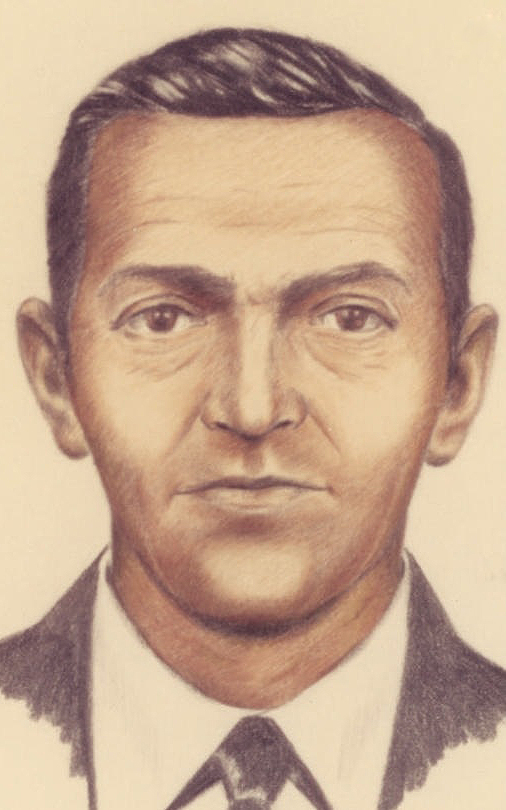
The last thing flight attendant Florence Schaffner expected when she dropped an unopened note into her purse was to become the key witness to America's most enduring criminal mystery. It was Thanksgiving Eve, 1971, and the neatly dressed businessman in seat 18-E had seemed unremarkable—until he leaned forward and whispered the words that would launch a forty-five-year investigation: "Miss, you'd better look at that note. I have a bomb."
What followed over the next few hours aboard Northwest Orient Flight 305 would establish the template for the perfect crime: methodical planning, courteous execution, and a vanishing act so complete that after nearly five decades, we still don't know who Dan Cooper really was—or whether he survived his leap into the November storm over southwestern Washington.
The Facts As We Know Them
The man who bought a one-way ticket to Seattle using the name "Dan Cooper" appeared to be everything a 1970s businessman should be: white, mid-forties, dark hair, brown eyes, wearing a black business suit with a white shirt and thin black tie. He carried a black attaché case and ordered bourbon and 7-Up. Nothing suggested he was about to execute the most audacious hijacking in aviation history.
Cooper's note, written in neat capitals with a felt-tip pen, was direct: "Miss—I have a bomb in my briefcase and want you to sit by me." When Schaffner complied and asked to see the device, Cooper obliged, revealing what appeared to be dynamite—two rows of four red cylinders connected by wires to a large battery. The professionalism of his approach would characterize every aspect of what followed.
His demands were specific and calculated. He wanted $200,000 in unmarked twenty-dollar bills—equivalent to roughly $1.6 million today—and four parachutes: two main chutes and two reserves. The request for duplicate parachutes was particularly shrewd, implying he might take a hostage and thereby ensuring authorities wouldn't sabotage the equipment.
For nearly two hours, Flight 305 circled Puget Sound while the FBI and Seattle police scrambled to meet Cooper's demands. During this time, witnesses consistently described his demeanor as calm, even pleasant. Flight attendant Tina Mucklow, who remained by his side as a liaison, later recalled: "He was not nervous. He seemed rather nice and he was not cruel or nasty."
Cooper's familiarity with the terrain didn't escape notice. Looking out the window, he correctly identified Tacoma below and demonstrated knowledge that McChord Air Force Base was only twenty minutes from Sea-Tac airport. When Mucklow asked why he'd chosen Northwest Airlines, Cooper laughed: "It's not because I have a grudge against your airline, it's just because I have a grudge."
At 5:46 PM, Flight 305 landed at Sea-Tac. Cooper methodically collected his ransom—10,000 twenty-dollar bills photographed on microfilm by the FBI, most bearing serial numbers beginning with "L" indicating issuance by the Federal Reserve Bank of San Francisco. He released all thirty-six passengers, keeping only the crew of six.
Cooper's flight plan for the second leg was as precise as his robbery: a southeast course toward Mexico City at minimum airspeed—approximately 100 knots—at 10,000 feet altitude maximum, with landing gear down, flaps at fifteen degrees, and the cabin unpressurized. When informed this configuration would require a refueling stop, he agreed to Reno-Tahoe International Airport.
Most remarkably, Cooper insisted the aft door remain open with the airstair extended—modifications that would prove crucial to his escape plan. At 7:40 PM, Flight 305 took off again into deteriorating weather conditions.
Into The Storm
What happened next exists only in fragments. Around 8:00 PM, approximately thirty minutes after takeoff and somewhere over the rugged terrain of southwestern Washington, Cooper lowered the aft stairs and stepped into a freezing rain storm wearing only his business suit and a parachute. The crew felt a sudden upward movement of the tail section—the only physical evidence of Cooper's departure.
He jumped into one of the most hostile environments imaginable: driving rain, near-freezing temperatures, 200-mph wind speed, and complete darkness over heavily forested wilderness. He carried with him at least some of the ransom money, having used his pocket knife to cut the canopy from one reserve parachute and stuff bills into the empty bag.
The crew continued to Reno, unaware of exactly when Cooper had jumped. It wasn't until they landed that investigators could pinpoint the approximate area of his descent: somewhere in the dense forests north of Portland, south of Mount St. Helens, in a region so remote that massive search efforts would yield virtually nothing.
The Silence That Followed
Despite one of the longest-running investigations in FBI history, the physical evidence remains startlingly thin. In 1980, nine years after the hijacking, $5,800 in deteriorating twenty-dollar bills was discovered along the Columbia River near Vancouver, Washington. The serial numbers matched Cooper's ransom money, but the discovery raised more questions than it answered. How had the money traveled from the presumed landing zone to the river? Why was it in such poor condition? Where was the rest?
The Columbia River find represents virtually the only confirmed physical trace of Cooper or his ransom. No parachute, no additional money, no remains, no personal effects have ever been definitively linked to the case. It's as if Cooper simply dissolved into the November storm.
The FBI's extensive case file, built over forty-five years of active investigation, failed to produce any definitive conclusions about Cooper's identity or fate. When the bureau officially suspended active investigation in 2016, they had examined hundreds of suspects, pursued countless tips, and applied evolving forensic techniques to limited evidence—all without resolution.
The Competing Theories
Cooper's fate has generated three primary schools of thought, each with compelling arguments and fatal weaknesses.
The Survival Theory suggests Cooper successfully executed his escape plan and lived to enjoy his proceeds. Proponents point to his apparent expertise—the sophisticated parachute request, knowledge of local geography, and calm demeanor under pressure. They argue his careful planning extended beyond the hijacking itself to include provisions for survival and escape. The absence of his body or definitive remains supports this view.
However, survival theorists must account for nearly impossible conditions: Cooper jumped at night in a severe storm, wearing inappropriate clothing, into rough terrain, carrying a heavy bag that would destabilize his descent. Even experienced skydivers considered the jump essentially suicidal.
The Death Theory maintains Cooper perished shortly after his jump, either during the descent or soon after landing. Weather conditions were severe—freezing rain, turbulence, near-zero visibility. Cooper's business attire provided no protection against hypothermia, and his dress shoes would have been useless for wilderness survival. The hostile terrain was notorious for swallowing aircraft and experienced hikers without a trace.
Yet if Cooper died quickly, why hasn't more evidence surfaced? The deteriorated condition of the Columbia River money suggests extended environmental exposure, but nine years seems insufficient to account for such degradation through natural causes alone.
The Partial Success Theory proposes Cooper survived the jump but died from exposure or injury before reaching civilization. This would explain the limited money discovery while accounting for the absence of his remains in such vast, difficult terrain. The bills could have been scattered from his landing site through natural causes—water runoff, animal activity, or seasonal flooding.
This compromise position addresses some logical inconsistencies but remains essentially unprovable without additional physical evidence.
The Professional Puzzle
Perhaps more intriguing than Cooper's ultimate fate is the question of his expertise. His apparent familiarity with parachuting, aviation, and regional geography suggests professional training, yet no law enforcement or military database has yielded a convincing match.
Cooper's request for specific parachute configurations demonstrated sophisticated knowledge. His flight plan requirements showed understanding of aircraft capabilities and limitations. His calm behavior under extreme pressure suggested prior experience with high-stakes situations. Yet this presumed professional vanished from all official records.
Multiple suspects emerged over the decades—disgruntled Boeing employees, former paratroopers, experienced skydivers—but none withstood sustained scrutiny. The FBI's inability to identify Cooper despite extensive investigation suggests either masterful identity concealment or a background somehow invisible to conventional law enforcement methods.
The Legend That Endures
Cooper's crime occurred at a unique moment in American history, when airport security was minimal and public sentiment toward authority was deeply skeptical. His polite demeanor, apparent concern for passenger safety, and audacious escape captured public imagination in ways that more violent crimes could not.
The immediate impact was transformative: metal detectors appeared at airports, baggage inspection became mandatory, and cash ticket purchasers faced additional scrutiny. Cooper's hijacking effectively ended the "golden age" of easy air travel, yet somehow he remained a folk hero rather than a villain.
The case officially remains open despite the FBI's suspended investigation. Amateur sleuths, journalists, and professional investigators continue pursuing leads, analyzing evidence, and proposing new theories. The absence of resolution has only amplified Cooper's mystique.
What We Still Don't Know
After more than fifty years, the fundamental questions remain unanswered. We don't know Cooper's real identity, his background, his expertise, or his ultimate fate. We don't know how he selected his target, planned his escape, or whether he survived to spend his ill-gotten gains.
The discovery of deteriorated money along the Columbia River suggests Cooper's story didn't end with a successful escape to tropical retirement, but it provides no clear resolution. The bills could represent the remains of a dead hijacker, the discarded evidence of a successful criminal, or simply a fragment of a larger mystery we may never fully comprehend.
What we do know is that on November 24, 1971, a polite stranger in a business suit walked onto an airplane, committed the perfect crime, and stepped into a storm that swallowed him whole. Whether Dan Cooper died in those dark woods or lived to become someone else entirely, he achieved something remarkable: he disappeared so completely that fifty years later, we're still looking for him.
In an age of surveillance and digital footprints, Cooper represents something increasingly impossible—the perfect vanishing. Perhaps that's why his story endures: not because of what he took, but because of how thoroughly he escaped, leaving behind only questions that grow more compelling with each passing year.
Log in or register to join the discussion.
Log in or register to post your theory.
No theories posted yet.